If an angiogram shows 70%, 80% or even 90% heart blockage, one of the first questions many patients ask is: Can EECP treatment help, or is angioplasty or bypass surgery the only option?
The answer is not as simple as looking at the blockage percentage.
EECP treatment for 70%, 80% or 90% heart blockage may be considered for some patients, particularly those who have persistent angina and limited treatment options. However, EECP does not physically remove plaque or open a severely narrowed coronary artery. The right treatment depends on factors such as the artery involved, symptoms, number of blockages, heart function, previous procedures and overall health.
At Cordis Heart Institute, patients can discuss their condition with Dr Abhijit Aklujkar and understand whether EECP or another treatment approach is appropriate for them.
What Does 70%, 80% or 90% Heart Blockage Mean?
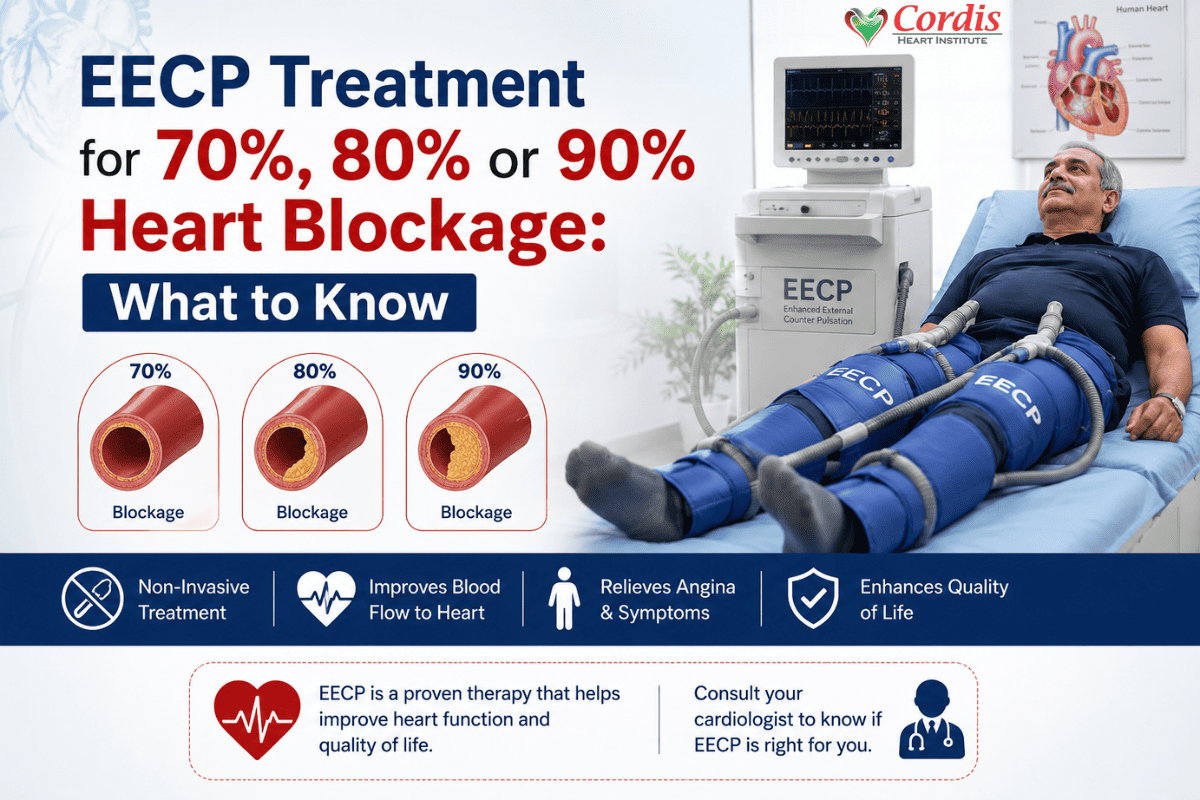
A heart blockage generally refers to narrowing in a coronary artery caused by plaque buildup. The percentage describes how much the artery’s diameter is narrowed compared with a reference segment.
But the percentage alone does not tell the whole story.
A 70% blockage in one artery may have a different treatment plan from a 70% blockage in another location. Doctors also consider blood flow, symptoms, the number of arteries affected and whether the heart muscle is receiving enough oxygen.
What Is a 70% Heart Blockage?
A 70% heart blockage represents substantial narrowing of a coronary artery. Depending on its location and the patient’s symptoms, a cardiologist may recommend medication, further testing or a procedure to restore blood flow.
A patient with a 70% blockage should not assume that EECP can simply remove the narrowing.
What Is an 80% Heart Blockage?
An 80% heart blockage indicates severe narrowing. It can reduce blood flow, particularly when the heart needs more oxygen during physical activity.
Chest discomfort, breathlessness or reduced exercise tolerance may occur, although some patients have few or no obvious symptoms.
The treatment decision depends on the complete cardiac assessment, not simply the “80%” figure.
What Is a 90% Heart Blockage?
A 90% heart blockage is very severe narrowing and needs careful medical assessment. Depending on the artery involved, symptoms and other findings, angioplasty with stenting or bypass surgery may be considered.
EECP should not be assumed to be an appropriate alternative simply because it is non-invasive.
What Is EECP Treatment for Heart Blockage?
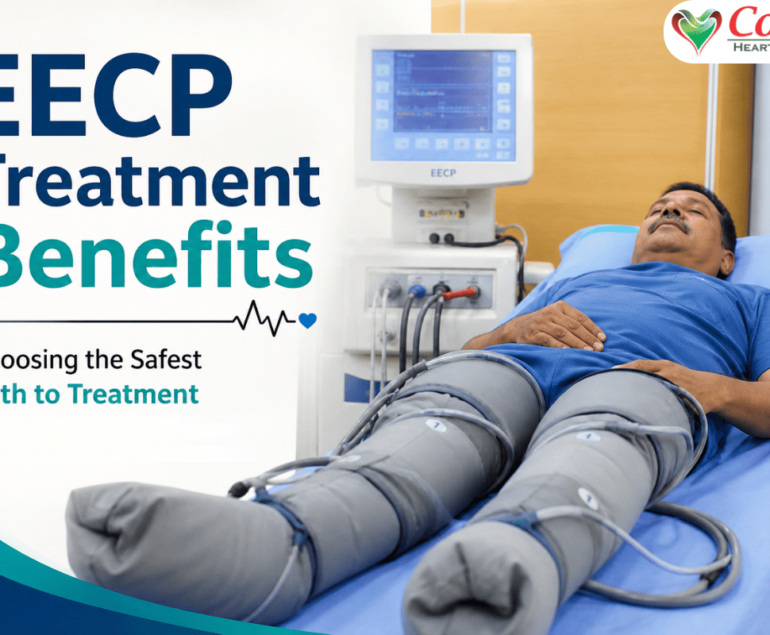
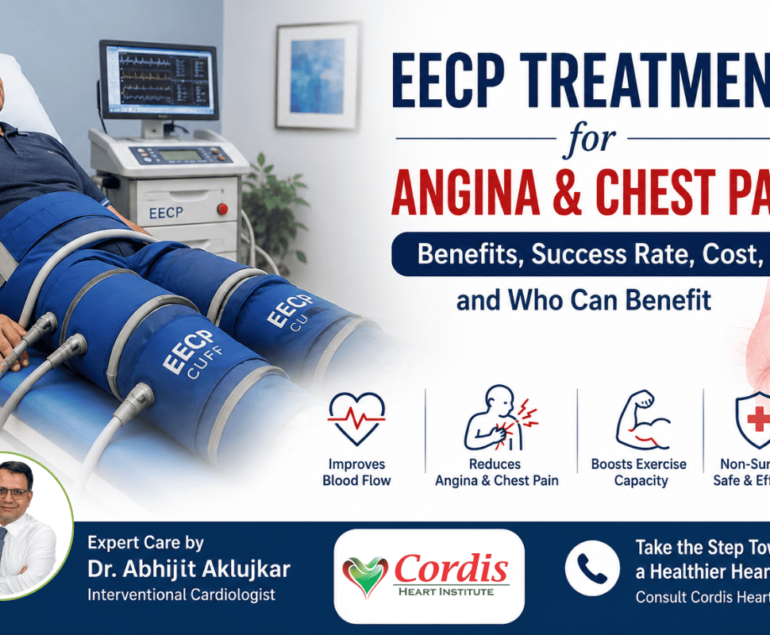
Enhanced External Counterpulsation (EECP) is a non-invasive treatment that uses inflatable cuffs placed around the calves, thighs and lower body.
The cuffs inflate and deflate in coordination with the patient’s heartbeat. Inflation during diastole can increase blood flow toward the heart, while rapid deflation before systole reduces resistance against which the heart pumps.
EECP is primarily used in selected patients with chronic or refractory angina. The 2023 AHA/ACC guideline states that EECP may be considered for symptom relief in patients with chronic coronary disease and refractory angina who have no other treatment options.
How Does EECP Improve Blood Flow to the Heart?
The treatment creates changes in blood-flow pressure and may improve coronary perfusion. Researchers have also studied possible effects on blood vessels, endothelial function and collateral circulation.
However, this does not mean EECP physically removes the plaque causing a coronary blockage.
How Many EECP Sessions Are Usually Needed?
A commonly studied course consists of about 35 one-hour sessions, usually five days a week for seven weeks.
The actual treatment plan should be decided by the treating medical team.
Is EECP Treatment Painful?
EECP is non-invasive, so there is no surgical incision or catheter inserted into the artery. Patients may feel pressure from the cuffs as they inflate and deflate. Some people may experience discomfort, bruising or skin irritation.
Can EECP Treat 70% Heart Blockage?
If you have a 70% heart blockage, EECP does not open that artery in the same way that angioplasty can.
Instead, EECP may be considered in selected patients who have ongoing angina and have limited options for invasive treatment. Clinical evidence has mainly focused on symptom relief and functional improvement in patients with refractory angina.
Who May Be Considered for EECP With 70% Blockage?
Potential candidates may include patients with:
- Persistent chronic stable angina
- Symptoms despite appropriate medical treatment
- Previous angioplasty or bypass with continuing symptoms
- Limited or unsuitable options for further revascularization
This does not mean every person with 70% blockage is suitable for EECP.
Can EECP Treat 80% Heart Blockage?
With an 80% blockage, the same principle applies. EECP does not physically clear the narrowed section of the artery.
A cardiologist first needs to understand whether the blockage is causing ischemia, where it is located, whether other arteries are affected and whether angioplasty or bypass would be more appropriate.
Is EECP an Alternative to Angioplasty for 80% Blockage?
Not automatically.
Angioplasty is designed to mechanically open a narrowed coronary artery, often with placement of a stent. EECP works externally and is mainly used for symptom relief in carefully selected patients.
So EECP vs angioplasty is not simply a choice between two versions of the same treatment. They have different purposes.
Can EECP Treat 90% Heart Blockage?
A 90% coronary artery blockage requires particularly careful evaluation.
If the blockage is suitable for revascularization, a cardiologist may consider angioplasty or bypass surgery depending on the patient’s coronary anatomy and clinical condition.
EECP may have a role in selected patients with refractory angina when other treatment options are limited, but it should not be promoted as a method for removing a 90% blockage. Current AHA/ACC guidance places EECP in a limited symptom-relief role for refractory angina when other treatment options are unavailable.
Can EECP Be Used When Angioplasty or Bypass Is Not Suitable?
In some carefully selected patients, yes. This is one of the situations in which EECP may be discussed.
The decision requires an assessment by a cardiologist rather than being based only on the percentage of blockage.
Does EECP Remove Heart Blockage?
No. EECP does not directly remove plaque from a blocked coronary artery.
This distinction is important.
Angioplasty uses a catheter-based procedure to widen a narrowed coronary artery, often followed by stent placement. Bypass surgery creates a new route for blood to flow around certain blocked or narrowed arteries.
EECP works differently. It uses external pressure cuffs to influence blood flow and cardiac workload.
So if you are searching for “Can EECP clear blocked arteries?”, the answer is no. EECP should not be described as a procedure that physically dissolves or removes a 70%, 80% or 90% blockage.
Its potential role is mainly related to symptom relief and functional improvement in selected patients with refractory angina.
EECP vs Angioplasty for 70%, 80% and 90% Blockage
Factor | EECP | Angioplasty |
Invasive procedure | No | Yes |
Directly opens blocked artery | No | Yes |
Stent required | No | Often used when appropriate |
Main approach | External counterpulsation | Catheter-based revascularization |
Main role | Selected patients with refractory symptoms | Appropriate coronary blockages requiring revascularization |
Neither treatment is automatically “better.”
The appropriate option depends on the patient’s coronary anatomy, symptoms, heart function, previous treatment and overall medical condition.
EECP vs Bypass Surgery for Severe Heart Blockage
Bypass surgery, also called coronary artery bypass grafting (CABG), creates a new pathway for blood to travel around certain blocked coronary arteries.
It can be considered when coronary disease is extensive or when the anatomy makes bypass more appropriate than catheter-based treatment.
EECP is completely different. It does not create a bypass and does not surgically alter the coronary arteries.
Therefore, EECP vs bypass surgery should be discussed with a cardiologist based on the patient’s individual condition rather than treated as a simple either-or choice.
Who May Benefit From EECP Treatment?
EECP may be considered for selected patients with chronic or refractory angina, especially when symptoms continue despite medical treatment and standard revascularization options are unavailable or unsuitable.
A cardiologist may consider factors such as:
- Severity and frequency of chest pain
- Previous angioplasty or bypass
- Coronary artery anatomy
- Heart pumping function
- Other medical conditions
- Response to medication
- Suitability for invasive treatment
Who Should Not Start EECP Without Medical Evaluation?
Patients should not begin EECP simply because they have been told they have a particular percentage of blockage.
Certain cardiovascular conditions, blood vessel problems, abnormal heart rhythms and other medical issues can affect suitability. A proper evaluation is therefore needed before starting treatment.
What Tests Are Needed Before EECP Treatment?
Before recommending EECP treatment for heart blockage, a doctor may review:
- Medical history and symptoms
- ECG
- Echocardiogram
- Blood pressure
- Stress testing when appropriate
- Coronary CT angiography or coronary angiography when indicated
- Previous angioplasty or bypass reports
- Current medications
Why the Percentage of Blockage Is Not the Only Factor
Two patients can have the same percentage of blockage but completely different treatment plans.
Doctors may look at:
- Where the blockage is located
- How many arteries are affected
- Whether the patient has angina
- Evidence of reduced blood flow
- Heart pumping function
- Diabetes and other risk factors
- Previous cardiac procedures
- Overall health
This is why a report saying “80% blockage” should be discussed with a cardiologist rather than interpreted in isolation.
What to Expect During EECP Treatment at Cordis Heart Institute
At Cordis Heart Institute, patients considering EECP can first undergo a cardiac evaluation to determine whether the treatment is appropriate.
EECP Treatment Process
A typical process may involve:
- Initial cardiac evaluation
The doctor reviews symptoms, medical history and available cardiac reports.
- Suitability assessment
The medical team determines whether EECP is appropriate based on the patient’s condition.
- EECP sessions
The patient lies comfortably while the pneumatic cuffs inflate and deflate in coordination with the heartbeat.
- Monitoring
The patient’s response is monitored during treatment.
- Follow-up
Symptoms and functional status can be reviewed after the treatment course.
Role of Dr Abhijit Aklujkar in EECP Evaluation
Dr Abhijit Aklujkar can evaluate the patient’s cardiac condition and discuss whether EECP is an appropriate option based on the individual’s symptoms, reports and treatment history.
The goal should be to choose an appropriate treatment plan rather than assuming that EECP is suitable for every blockage.
Benefits and Limitations of EECP for Heart Blockage
Potential Benefits
For selected patients, EECP may:
- Provide a non-invasive treatment option
- Help reduce angina symptoms
- Improve exercise tolerance in some patients
- Avoid an additional invasive procedure when no suitable revascularization option exists
Studies have reported improvements in angina symptoms and functional status, although the quality and consistency of evidence vary across studies.
Important Limitations
EECP:
- Does not physically remove coronary plaque
- Does not automatically replace angioplasty
- Does not automatically replace bypass surgery
- Is not suitable for every patient
- Should not be used instead of emergency cardiac care
The 2023 AHA/ACC chronic coronary disease guideline gives EECP a Class 2b recommendation for symptom relief in patients with refractory angina who have no other treatment options, reflecting its selective role rather than routine use for all coronary blockages.
Is EECP Safe for Patients With Severe Heart Blockage?
EECP is a non-invasive treatment, but “non-invasive” does not mean appropriate for everyone.
Patients with severe coronary disease should first be evaluated by a qualified cardiologist. The doctor can review the patient’s angiogram, symptoms, medications, heart function and other health conditions before deciding whether EECP is suitable.
If symptoms suggest an acute cardiac problem, EECP is not a substitute for emergency medical care.
EECP Treatment Cost for Heart Blockage
The EECP treatment cost can vary depending on the treatment plan and healthcare facility.
Factors that can affect the total cost include:
- Number of EECP sessions
- Initial consultation
- Diagnostic tests
- Monitoring
- Follow-up appointments
- Individual treatment requirements
Patients looking for EECP treatment cost in Mumbai should contact the treatment centre directly for current pricing rather than relying on a generic figure found online.
At Cordis Heart Institute, patients can discuss their reports and treatment requirements before deciding whether EECP is appropriate.
When Should You See a Cardiologist for Heart Blockage?
Do not wait for an EECP consultation if you have new or worsening symptoms.
Contact a doctor promptly if you experience:
- Chest pressure or pain
- Breathlessness
- Unusual sweating
- Pain spreading toward the arm, jaw, shoulder or back
- Unusual fatigue during activity
- Repeated episodes of angina
When Is Chest Pain an Emergency?
New, severe, persistent or worsening chest pain can be a medical emergency.
Chest pain accompanied by breathlessness, fainting, heavy sweating or other concerning symptoms should receive urgent medical attention. Do not wait to see whether EECP will help.
Frequently Asked Questions About EECP for 70%, 80% and 90% Heart Blockage
Can EECP treat a 70% heart blockage?
EECP does not physically remove a 70% blockage. In selected patients, it may be considered for relief of persistent angina when other treatment options are limited.
Can EECP treat an 80% heart blockage?
EECP may be considered for certain patients with ongoing symptoms, but the blockage percentage alone does not determine suitability. A cardiologist must assess the patient’s complete condition.
Can EECP treat a 90% heart blockage?
A 90% blockage requires careful evaluation. Depending on its location and other clinical factors, angioplasty or bypass may be considered. EECP may have a role only in selected situations.
Does EECP clear blocked arteries?
No. EECP does not mechanically remove plaque from coronary arteries.
Can EECP prevent bypass surgery?
It should not be presented as a way to prevent bypass surgery in every patient. Whether bypass is needed depends on coronary anatomy and the patient’s clinical condition.
Is EECP better than angioplasty?
They serve different purposes. Angioplasty can directly open a suitable narrowed coronary artery, while EECP is a non-invasive treatment mainly considered for symptom relief in selected patients.
How many EECP sessions are required?
A commonly used course is around 35 one-hour sessions over seven weeks, although the treatment plan can vary.
Is EECP safe for elderly heart patients?
Age alone does not determine suitability. An elderly patient should undergo a medical assessment to determine whether EECP is appropriate.
Can EECP be done after angioplasty?
It may be considered in selected patients who continue to experience angina after previous revascularization, depending on their overall cardiac condition.
Can EECP help patients with multiple heart blockages?
It may be considered in selected patients, but multiple blockages require careful assessment of coronary anatomy, symptoms and available treatment options.
Conclusion: Is EECP Right for 70%, 80% or 90% Heart Blockage?
Being told that you have 70%, 80% or 90% heart blockage can be frightening. But the percentage on an angiogram is only one part of the treatment decision.
EECP does not remove or dissolve coronary artery blockage. Its role is mainly in selected patients with chronic or refractory angina, particularly when other treatment options are limited. Current AHA/ACC guidance supports considering EECP for symptom relief in patients with refractory angina who have no other treatment options.
If you have been diagnosed with severe coronary artery blockage, do not choose a treatment based only on online information. Discuss your angiogram, symptoms and medical history with a cardiologist.
Talk to a Cardiologist About Your Heart Blockage
If you have been diagnosed with 70%, 80% or 90% heart blockage and want to know whether EECP may be suitable for you, consult Dr Abhijit Aklujkar at Cordis Heart Institute for an individual cardiac evaluation.
The right question is not simply “Can EECP treat my blockage?” It is “What treatment is appropriate for my particular heart condition?”