Paralysis can change a person’s ability to walk, speak, use their hands or perform everyday activities. When paralysis happens after a stroke, families often look for additional treatment options that may support recovery. One question that comes up is: Can EECP treatment for paralysis help improve recovery?
EECP, or Enhanced External Counterpulsation, is a non-invasive therapy that works by using inflatable cuffs around the legs to influence blood flow. While EECP has established cardiovascular applications, its possible role in stroke recovery is still being studied.
It is important to be clear from the beginning: EECP should not be presented as a cure for paralysis or a replacement for stroke rehabilitation. Whether it has a role in an individual patient depends on the cause of paralysis, overall health, cardiovascular condition and medical assessment.
For patients considering EECP treatment in Mumbai, a discussion with an experienced doctor can help determine whether this therapy is appropriate. At Cordis Heart Institute, patients can consult Dr Abhijit Aklujkar about their condition and treatment options.
What Is EECP Treatment?
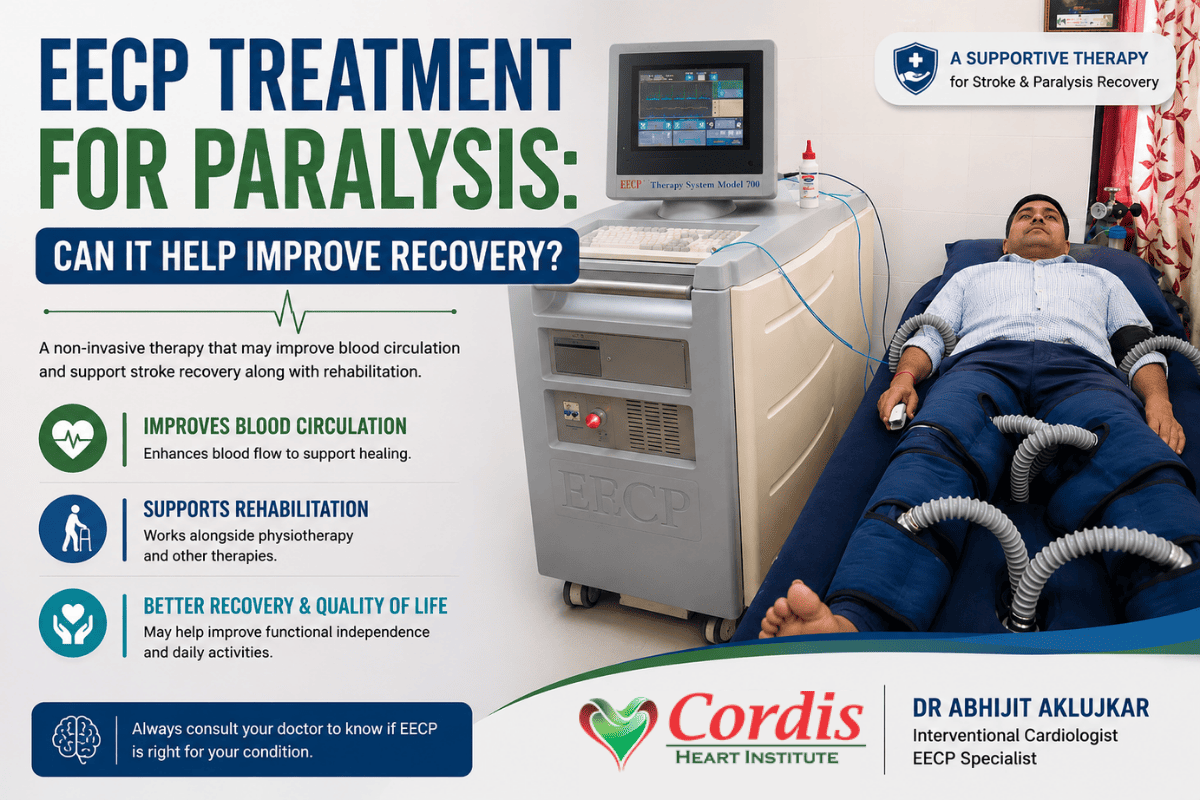
EECP stands for Enhanced External Counterpulsation. It is a non-invasive treatment in which inflatable cuffs are placed around the calves, thighs and buttocks.
The cuffs inflate and deflate in coordination with the patient’s heartbeat. This creates a pumping effect that can influence blood circulation.
During treatment, the patient usually lies comfortably on a treatment bed while the machine and vital signs are monitored by the medical team.
How Does EECP Therapy Work?
The treatment uses sequential inflation of the cuffs around the lower body. The timing is coordinated with the cardiac cycle.
The basic process involves:
- The patient lies on the treatment bed.
- Cuffs are placed around the legs and lower body.
- The machine synchronizes cuff inflation with the heartbeat.
- The cuffs inflate and deflate in a controlled sequence.
- The treatment is monitored by trained medical professionals.
EECP is primarily known as a circulation-focused cardiovascular therapy. Its potential use in neurological recovery is a separate area of medical research.
What Is Paralysis and Why Can a Stroke Cause It?
Paralysis refers to loss or impairment of the ability to move part or parts of the body. The extent can vary widely depending on the underlying cause and the area affected.
A stroke can damage areas of the brain responsible for movement, coordination and other functions. As a result, some stroke survivors may experience weakness or paralysis affecting one side of the body.
Recovery is not the same for everyone. Some people regain substantial function, while others may have longer-term difficulties.
This is why paralysis rehabilitation is an important part of post-stroke care.
Why Is Rehabilitation Important After Paralysis?
Stroke rehabilitation can include:
- Physiotherapy
- Occupational therapy
- Speech and language therapy
- Mobility and balance training
- Cognitive rehabilitation
- Home-based rehabilitation
- Regular medical follow-up
The American Stroke Association states that rehabilitation aims to help stroke survivors regain as much independence as possible and can address movement, speech, strength and daily activities.
Can EECP Treatment Help Improve Paralysis Recovery?
This is the key question, and the answer needs some care.
EECP is not a proven direct treatment that reverses paralysis. However, researchers have studied whether changes in blood circulation associated with EECP could have a supportive role in neurological recovery after stroke.
A 2026 systematic review and meta-analysis examined 15 studies involving 506 participants with ischemic stroke. It found that the evidence for improved cerebral blood flow was uncertain when a more conservative statistical analysis was applied. This means more research is needed before EECP can be considered an established treatment for stroke-related paralysis.
Another randomized controlled study investigated external counterpulsation in relation to neuroplasticity and stroke recovery, showing why this area continues to attract research interest.
So, if someone asks, “Is EECP effective for paralysis?”, the responsible answer is that its neurological benefits are still being investigated. It should not be promoted as a guaranteed method for restoring movement.
How EECP May Support Blood Circulation
EECP is designed to influence circulation by using timed pressure from cuffs around the lower body.
This is different from saying that EECP can repair brain damage caused by a stroke. Better circulation does not automatically mean that damaged brain tissue will recover.
Any possible role of EECP in stroke recovery therefore needs to be considered alongside the patient’s diagnosis and rehabilitation plan.
EECP and Stroke Recovery: Can They Be Combined?
In selected patients, EECP may be considered as an additional therapy rather than a replacement for established rehabilitation.
A stroke recovery plan may include:
- Physiotherapy for movement and strength
- Occupational therapy for daily activities
- Speech therapy for communication or swallowing problems
- Neurological care
- Cardiovascular management
- Prescribed medication
- Home rehabilitation
The American Stroke Association recommends individualized rehabilitation based on the patient’s needs and abilities.
This is an important point for families considering EECP therapy after stroke: adding a treatment should not mean stopping therapies that already form the foundation of stroke rehabilitation.
Who May Be Considered for EECP After Paralysis or Stroke?
Not every person with paralysis is a candidate for EECP.
Before treatment, a doctor may consider:
- The cause of paralysis
- Type and severity of stroke
- Current neurological condition
- Cardiovascular health
- Blood pressure
- Existing heart conditions
- Current medications
- Mobility and rehabilitation status
- Other medical conditions
A proper medical evaluation is therefore necessary before starting EECP therapy for paralysis.
The goal is not simply to ask whether EECP is available. The more useful question is whether it is medically appropriate for that particular patient.
Who May Not Be Suitable for EECP?
EECP is not appropriate for everyone. Certain cardiovascular, vascular, blood pressure, rhythm or other medical conditions may require special caution.
Pregnancy and certain medical conditions may also affect eligibility.
For this reason, patients should not use a general online checklist to decide whether they can undergo treatment.
A treating medical team should determine whether EECP is suitable after reviewing the patient’s medical history and current condition.
What Happens During an EECP Treatment Session?
Before the Session
The medical team may review the patient’s medical history, medications and vital signs. Any relevant cardiovascular or vascular concerns should be assessed before treatment.
During EECP Therapy
The patient lies on a treatment bed while cuffs are placed around the calves, thighs and buttocks.
The machine coordinates cuff inflation and deflation with the heartbeat. Treatment is monitored throughout the session.
After the Session
Patients may experience temporary leg or muscle discomfort, skin irritation or bruising. The treatment schedule and number of sessions depend on the individual treatment plan.
How Many EECP Sessions Are Needed?
There is no single number of EECP sessions that can be recommended for every person with paralysis or after a stroke.
The treatment schedule depends on the patient’s medical condition, treatment goals and doctor’s assessment.
Patients should also avoid judging neurological recovery only by whether they feel an immediate change after an individual session. Functional progress is better assessed over time with the rehabilitation team.
EECP vs Conventional Paralysis Rehabilitation
Treatment | Main Role |
Physiotherapy | Movement, strength and mobility |
Occupational therapy | Daily activities and independence |
Speech therapy | Speech, communication and swallowing |
Neurological care | Diagnosis and medical management |
EECP | Circulation-focused therapy that may have a supportive role in selected patients |
EECP should not replace conventional stroke rehabilitation.
Potential Benefits and Limitations of EECP for Paralysis Recovery
Potential Benefits
EECP may offer certain advantages in appropriately selected patients:
- It is non-invasive.
- It is designed to influence blood circulation.
- It can be performed under medical supervision.
- It is being studied as a possible additional therapy in neurological recovery.
Limitations
Patients should also understand what EECP cannot promise.
- It is not a guaranteed paralysis treatment.
- It is not suitable for every patient.
- Evidence for neurological recovery is less established than its cardiovascular applications.
- It cannot replace stroke rehabilitation.
- Results can vary between individuals.
Being realistic about these points helps patients make better treatment decisions.
Is EECP Safe for Paralysis Patients?
EECP may cause temporary discomfort in some patients, including skin irritation, leg discomfort, muscle discomfort or bruising.
Safety depends on the individual’s medical condition. Patient screening, monitoring during treatment and review of medications are important parts of the process.
If a patient has recently experienced a stroke, the doctor should also consider the patient’s neurological and cardiovascular status before recommending any additional therapy.
Choosing an EECP Treatment Centre in Mumbai
If you are searching for EECP treatment for paralysis in Mumbai, do not choose a centre based only on advertisements or promises of recovery.
Before starting treatment, ask:
- Is the patient properly evaluated before EECP?
- Is treatment medically supervised?
- Will the patient’s existing doctors be involved when needed?
- Is the treatment plan clearly explained?
- What outcome can realistically be expected?
- How will progress be monitored?
- Can EECP be used alongside the patient’s rehabilitation program?
EECP Treatment at Cordis Heart Institute
At Cordis Heart Institute, patients considering EECP can discuss their medical history and treatment options with Dr Abhijit Aklujkar.
The focus should be on determining whether EECP is appropriate for the patient’s condition rather than assuming that the treatment will reverse paralysis.
Considering EECP after stroke or for paralysis-related recovery? Consult Dr Abhijit Aklujkar at Cordis Heart Institute to discuss your medical history, current condition and whether EECP may be appropriate for you.
Frequently Asked Questions About EECP Treatment for Paralysis
Can EECP treatment help with paralysis recovery?
EECP is not established as a direct cure for paralysis. Research is examining whether it may have a supportive role in recovery after stroke, but current evidence does not justify promising paralysis reversal.
Is EECP effective for stroke-related paralysis?
Its effectiveness for stroke-related paralysis remains an area of research. A recent systematic review found uncertainty around improvements in cerebral blood flow when more conservative statistical methods were used.
Can EECP improve blood circulation after a stroke?
EECP is designed to affect blood circulation. However, improved circulation should not be interpreted as proof that damaged brain tissue will recover or that paralysis will be reversed.
Is EECP a replacement for physiotherapy after paralysis?
No. Physiotherapy and other rehabilitation services remain important parts of stroke recovery.
How many EECP sessions are needed for paralysis?
There is no universal number of sessions for paralysis recovery. The schedule should be decided by the treating medical team based on the patient’s condition.
Is EECP safe after a stroke?
Suitability depends on the patient’s neurological, cardiovascular and overall medical condition. A doctor should evaluate the patient before treatment.
Can EECP be combined with stroke rehabilitation?
In selected patients, it may be considered as an additional therapy. It should be coordinated with the patient’s existing rehabilitation and medical care.
Where can I get EECP treatment in Mumbai?
Patients looking for EECP treatment in Mumbai can consult Cordis Heart Institute and discuss their condition with Dr Abhijit Aklujkar to determine whether EECP is appropriate.
Final Takeaway: Can EECP Help With Paralysis Recovery?
The interest in EECP treatment for paralysis comes from the possibility that circulation-focused therapy may have a supportive role in neurological recovery. Research into EECP and stroke recovery is ongoing, but the current evidence does not support presenting EECP as a cure for paralysis.
For most stroke survivors, rehabilitation remains a central part of recovery. Physiotherapy, occupational therapy, speech therapy and appropriate medical care work together to address the problems caused by stroke.
If you or a family member is considering EECP therapy after stroke, the right starting point is a medical assessment. Discuss the potential benefits, limitations and risks with your doctor before making a decision.
For patients in Mumbai, Dr Abhijit Aklujkar at Cordis Heart Institute can assess the patient’s condition and discuss whether EECP may have a role in the overall treatment plan.